
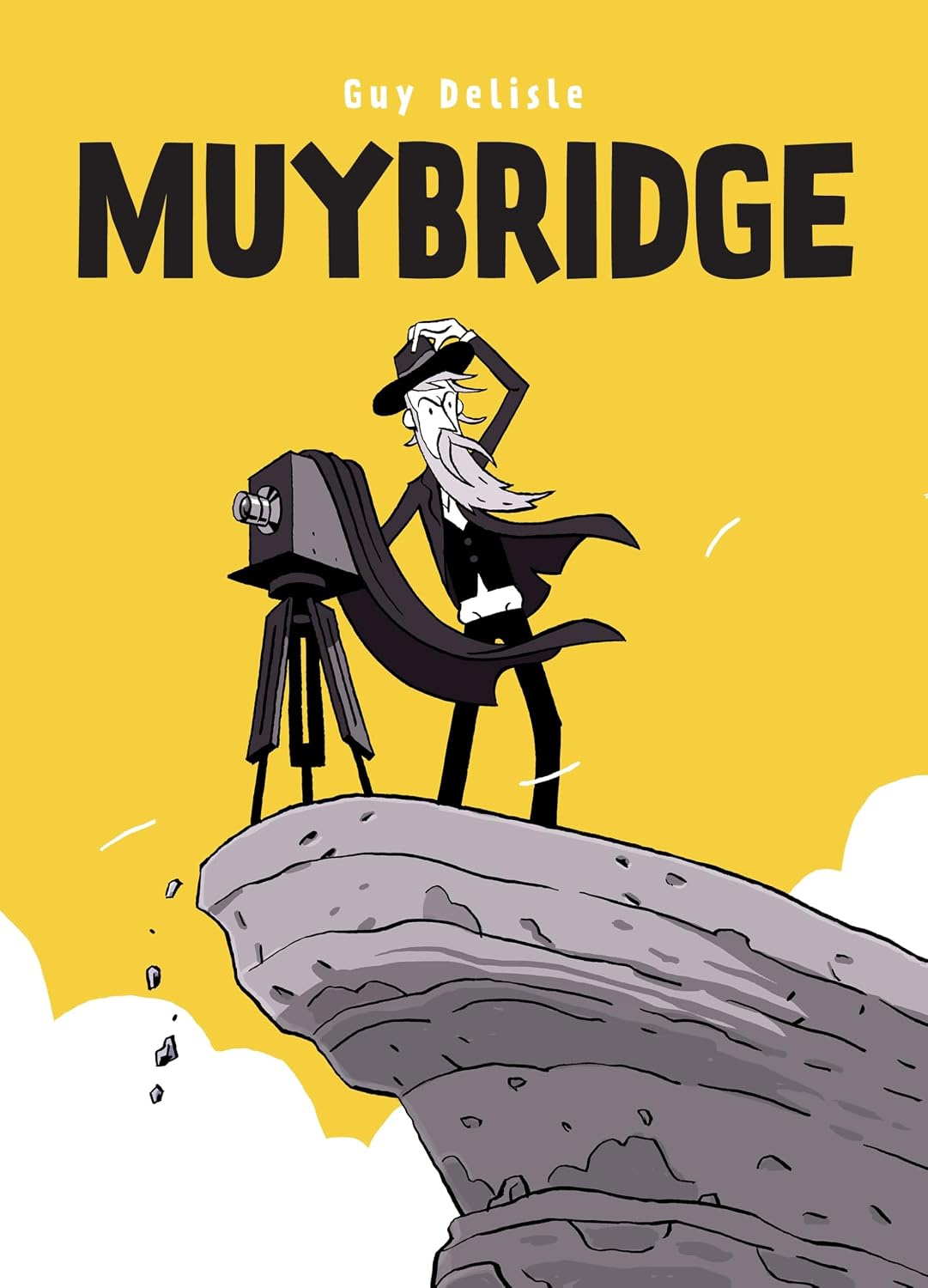
 Join the HCSF Reading Group to discuss Muybridge by Guy Delisle
In-Person Meeting
Sunday, November 15, 2026
4:30-6:00 pm Pacific
In-Person, SF, CA
Address emailed to registrants a week before the meeting
Carpools can be arranged
HCSF Members: Free, but RSVP required
Non-Members: $10 Not a member? Register here for membership!
Please sign in with your HarvardKey otherwise a duplicate record will be created and you will not be able to log-in.
No HarvardKey? Please retrieve your HarvardKey here. If you need help, email ithelp@harvard.edu or call 617-495-7777
HCSF Guidelines for attending in-person events
If you are showing COVID-19 or Flu symptoms, please stay home. This is critical to the health and safety of our staff and communities.
Registration ends Friday, November 13
Muybridge
Guy Delisle
2025 216 pages
This will be the first graphic book ever discussed by the HCSF Reading Group.
Depending on who you ask, groundbreaking photographer Eadweard Muybridge was either an eccentric, a genius or a total psychopath. What is not in dispute is the impact he had on the earliest days of photography and, by sheer ripple effect, moviemaking. Delisle successfully captures Muybridge’s downright dogged pursuit of images that might enlighten the world — particularly those of animals and humans in motion. Famously, Muybridge was the first photographer to prove that horses lift all four hooves off the ground while galloping.
Delisle seeks to retrace the Englishman’s life in San Francisco, his work with Leland Stanford, and the legendary images he captured of Yosemite more than 20 years before the expanse became a national park. In telling his story, Guy Delisle’s Muybridge also breaks down the earliest days of commercial photography and how so many technical innovations came about in the latter half of the 19th century. Spanning the years between 1850 and 1904, the book acts as a handy glimpse into Bay Area culture during the Victorian era.
Making all of these history lessons more compelling, the author never once forgets about the idiosyncrasies, recklessness and fits of short-tempered rage that also shaped Muybridge’s life and work. He was a man who seemed to have no qualms about committing both child neglect and, rather notoriously, murder. The story sticks closely to events in Muybridge’s life, but, outside of suggesting that a head injury may have impacted his personality, the book doesn’t really explain why Muybridge was such a peculiar character.
While the graphic biography is alive with expressive characters and delightfully detailed depictions of the architecture of the period, the thing that really elevates Muybridge is its use of historical photography. The first photograph ever taken by Nicéphore Niépce in 1827 is here. As is a French street scene captured by Louis Daguerre in 1838. Then, of course, there’s the work of Muybridge himself. These include an image of him defying death while sitting precariously at the end of a cliff in 1872. There are images he captured of Stanford’s famously doomed Nob Hill mansion. And, of course, those famous shots of the horse in motion — as well as a plethora of other animals. (KQED)
Questions about our meetings or how we choose our books?
Contact Kirsten Miclau
HCSF Reading Group Organizer
readinggroup@harvardclubsf.org